


When you first hear "foam bed for toddlers," your instinct might be skepticism. Foam? For a child's primary sleep surface? Those instincts are worth exploring. Safety should never be taken on faith, especially when it comes to where your child sleeps.
What the CPSC Says About Toddler Beds
The U.S. Consumer Product Safety Commission (CPSC) regulates toddler beds under ASTM F1821, a mandatory federal safety standard. This standard covers structural integrity, entrapment hazards, and stability requirements for beds designed for children who have outgrown a crib.
Key CPSC requirements include:
- No entrapment hazards (openings that could trap a child's head or limbs)
- Structural integrity under specified weight loads
- Stability to prevent tipping
- Lead content limits on accessible surfaces (under 90 ppm)
- No small parts that present choking hazards
- Compliance with the Children's Product Safety Improvement Act (CPSIA)
These standards apply regardless of material. A foam bed, a wood bed, and a metal bed all must meet the same safety thresholds. The material itself is not a safety concern in the eyes of federal regulators: what matters is how the product performs against standardized tests.
CertiPUR-US Certification: What It Actually Means
CertiPUR-US is an independent certification program that tests foam for content, emissions, and durability. It's the gold standard for foam safety in the United States, and any foam bed you're considering for your child should carry this certification.
A CertiPUR-US certified foam has been tested and verified to be:
- Free of ozone depleters: no CFCs or other chemicals that damage the ozone layer.
- Free of PBDEs and TDCPP flame retardants: these are the toxic flame retardants that prompted widespread consumer concern about foam products. CertiPUR-US certified foams do not contain them.
- Free of mercury, lead, and other heavy metals: critical for any product a child will be in close contact with for hours every night.
- Low in VOC emissions: volatile organic compounds are the "new product smell" that comes from some foams. CertiPUR-US limits emissions to less than 0.5 parts per million, well below levels that could affect indoor air quality.
- Free of formaldehyde: no added formaldehyde in the manufacturing process.
- Free of prohibited phthalates: phthalates are chemicals used as plasticizers that have been linked to health concerns in children. CPSC-regulated phthalates are not present in CertiPUR-US certified foam.
The Little Duck Bed uses CertiPUR-US certified foam exclusively. Every batch is tested, and the certification is maintained through ongoing compliance, not a one-time check.
Foam Density and Firmness: Why 33D Matters
Not all foam is created equal. The density of foam (measured in kg/m3, often shortened to "D") determines how supportive and durable it is. Low-density foam (under 20D) is what you find in cheap couch cushions: it compresses quickly, sags over time, and doesn't provide adequate support for sleep.
High-density foam (30D and above) is a different material entirely. At 33D, the foam used in the Little Duck Bed provides:
- Firm, flat sleep surface: meets the AAP recommendation for a firm sleep surface for toddlers. The foam doesn't create divots or sink spots that could pose positional risks.
- Long-term durability: high-density foam maintains its shape and firmness for years, not months. Your child's bed at age 2 will feel the same at age 5.
- Even weight distribution: supports growing bodies without pressure points, promoting healthy sleep posture.
- Resilience: springs back to its original shape after compression. This is why the bed can ship compressed in a box and expand to full size within hours.
When evaluating any foam bed, ask for the density rating. If a manufacturer won't tell you, that's a red flag. Anything below 25D is not appropriate for a child's primary sleep surface.
No Toxic Flame Retardants: A Closer Look
Flame retardant chemicals in children's products have been a legitimate concern for parents for over a decade. Historically, many foam products were treated with chemical flame retardants (like PBDEs and TDCPP) to meet flammability standards. Research has since linked these chemicals to health risks, particularly for children.
The good news: the industry has shifted significantly. CertiPUR-US certified foams do not contain PBDE or TDCPP flame retardants. Modern foams can meet flammability requirements through inherent material properties and barrier fabrics rather than chemical treatment.
The Little Duck Bed uses CertiPUR-US certified foam with no added toxic flame retardants. The foam meets safety standards through its material composition, not through chemical additives that could affect your child's health.
Foam vs. Wood: A Safety Comparison
Wood toddler beds and floor beds are the traditional choice, and many are well-made products. But the material itself introduces safety considerations that foam simply doesn't have:
Wood Bed Safety Concerns
- Recalls: the CPSC has issued numerous recalls on wood toddler beds and children's furniture for issues including slat breakage, entrapment hazards, and structural failure. Wood components can crack, split, or loosen over time.
- Splinters: as wood ages, especially in humid environments, splinters become increasingly common. A toddler running their hand along a bed rail at 2 AM is not being careful.
- Hard edges and corners: even rounded wood edges are still hard surfaces. A toddler rolling into a wood bed frame is going to feel it.
- Hardware: screws, bolts, and brackets can loosen with use. Small parts that work their way free present both choking and pinch hazards.
- Paint and finish: the coating on wood beds must be lead-free and non-toxic. Most reputable brands comply, but cheaper imports have been flagged in recalls for excessive lead content in paint.
Why Foam Addresses These Concerns
- No hard surfaces: a foam bed has no rigid components. Contact with any part of the bed is inherently soft.
- No hardware: no screws, bolts, brackets, or small parts to loosen, break, or present choking hazards.
- No splinters: foam does not splinter, crack, or degrade in the same way wood does.
- No entrapment risk from structural gaps: a solid foam bed doesn't have slats, rails, or openings where a child could get stuck.
- Washable covers: the removable, machine-washable cover on the Little Duck Bed means the sleep surface stays clean and hygienic without harsh chemical cleaners.
This is not to say all wood beds are unsafe. Many are excellent products. But the inherent properties of foam eliminate several categories of risk that wood products must actively engineer around.
AAP Recommendations and Floor Bed Safety
The American Academy of Pediatrics (AAP) provides clear guidelines for safe sleep:
- For infants (0–12 months): firm, flat sleep surface in a crib or bassinet. No floor beds, no exceptions.
- For toddlers (12 months+): transition to a toddler bed or other appropriate sleep surface when the child outgrows the crib (reaches 35 inches or begins climbing out).
A floor bed at 12 months or older is consistent with AAP recommendations, provided the sleep surface is firm, the room is safe, and no soft, loose bedding is used. The Little Duck Bed's 33D foam provides a firm, flat surface that aligns with these guidelines.
Little Duck Bed Safety Features
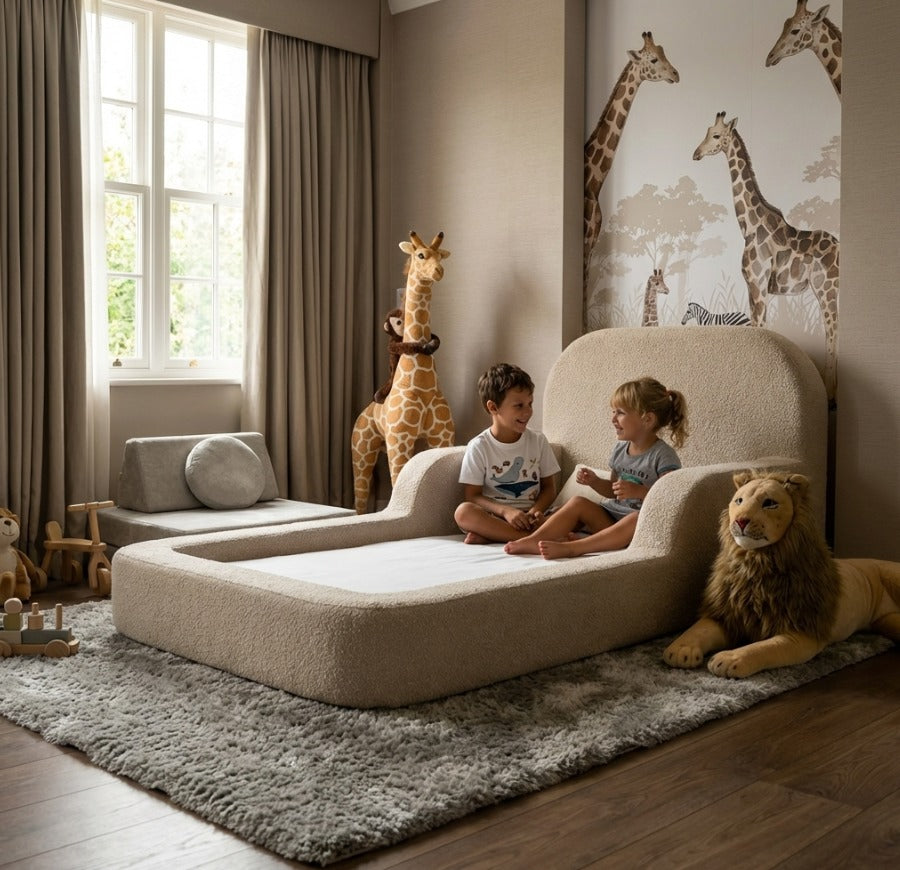
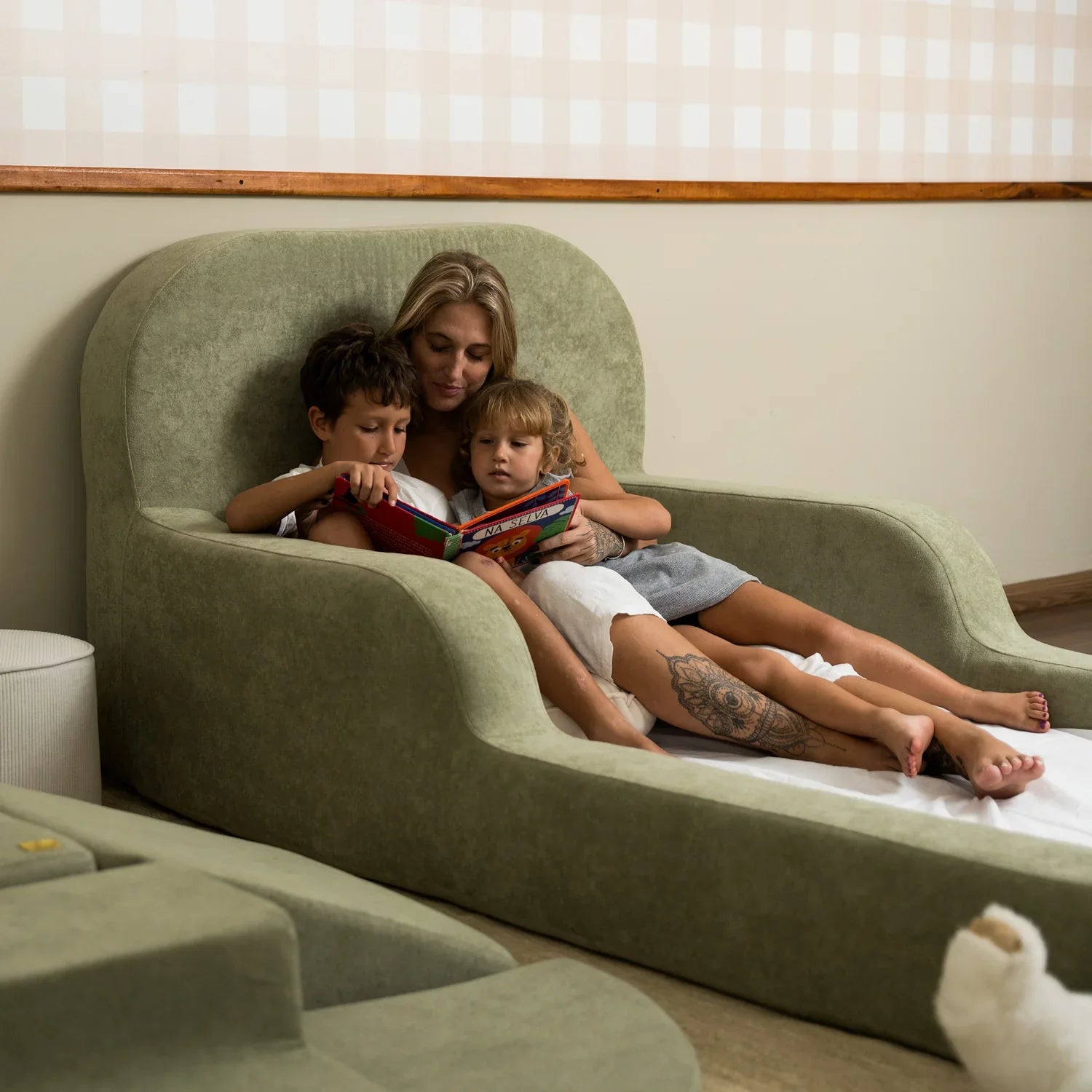
100% high-density foam (33D), no wood, no metal. CertiPUR-US certified: no toxic flame retardants, no heavy metals, low VOC. Zero sharp edges, corners, or hard surfaces. No screws, bolts, or small hardware parts. Removable, machine-washable covers (hypoallergenic, antibacterial). CPSC/CPSIA compliant design. Firm, flat sleep surface per AAP guidelines. Ships compressed, sets up in minutes (no tools).
Available in five colors: Sky Blue, Stone Castle Gray, Vanilla Linen, Fairy Blossom Pink, and Olive Green.
Frequently Asked Questions
Is foam firm enough for a toddler to sleep on safely?
Yes, when the foam is high-density (30D or above). The Little Duck Bed uses 33D foam, which provides a firm, flat sleep surface consistent with AAP recommendations. Low-density foam (under 20D) would not be appropriate, which is why density rating is the most important specification to check when evaluating any foam sleep product for children.
What is CertiPUR-US, and why does it matter for a children's bed?
CertiPUR-US is an independent certification program that tests foam for harmful chemicals, including toxic flame retardants (PBDEs, TDCPP), heavy metals (lead, mercury), formaldehyde, and phthalates. It also tests for VOC emissions to ensure good indoor air quality. For a product your child sleeps on for 10–12 hours every night, this certification provides independent verification that the foam is free of substances known to be harmful.
Are foam beds safer than wood beds for toddlers?
Foam and wood beds must meet the same federal safety standards (ASTM F1821). However, foam beds inherently eliminate several risk categories that wood beds must engineer around: hard edges, splinters, loose hardware, and entrapment gaps between slats or rails. Neither material is inherently "unsafe," but foam's physical properties remove more potential failure points from the equation.
Does the Little Duck Bed contain any flame retardant chemicals?
No. The Little Duck Bed uses CertiPUR-US certified foam that does not contain PBDE, TDCPP, or other toxic flame retardant chemicals. Modern high-density foams can meet flammability safety requirements through their material composition and barrier fabrics rather than chemical treatment. This is verified through CertiPUR-US's ongoing testing and compliance program.
See the safety for yourself
CertiPUR-US certified. CPSC compliant. Zero sharp edges. The safest Montessori bed, made of foam.
Shop Montessori Beds

Leave comment
This site is protected by hCaptcha and the hCaptcha Privacy Policy and Terms of Service apply.