


Search "montessori house bed" and you will find hundreds of wooden A-frame beds with peaked roofs and slat walls. They look charming. But the house bed concept is about more than aesthetics: it is a floor-level sleeping space that gives your child independence. The question is whether the traditional wooden house frame is the best way to deliver that.
What Makes a Bed a "Montessori House Bed"
The term combines two things: the Montessori floor bed philosophy (child can get in and out independently, mattress close to or on the floor) and a house-shaped frame (peaked roof, sometimes with side rails that double as walls). Maria Montessori never specified a house shape. She specified floor-level access, freedom of movement, and a prepared environment. The house shape is a modern design layer that parents added because it looks wonderful on Instagram and gives children a cozy "den" feeling.
Understanding this distinction matters because it changes what you prioritize when shopping. If you want the Montessori benefits (autonomy, safe rolling, floor access), the frame shape is optional. If you want the cozy aesthetic AND the Montessori benefits, you have more options than just wood.
Traditional Wood House Bed: Pros and Limits
What wood does well
- Structural presence: a pine or birch house frame becomes an anchor piece in the room
- Decorative potential: parents drape fairy lights, fabric canopies, and garlands over the roof peak
- Longevity: a well-built hardwood frame can last through multiple children
Where wood house beds fall short
- Hard edges and corners: every joint, every slat, every roof peak is a rigid surface. Toddlers roll, climb, and stumble into bed edges nightly
- Assembly complexity: most house beds arrive as 30-60 pieces with an Allen key and 2-3 hours of assembly time
- Mattress sold separately: you still need to source a mattress that fits the frame perfectly with no dangerous gaps
- Weight and moving: a typical wood house bed weighs 40-60 lbs. Rearranging the room means a two-person job
- Off-gassing: MDF or pressed wood frames can release formaldehyde. Solid wood with varnish or paint adds its own VOCs
Foam Floor Beds: A Different Approach
A foam floor bed delivers every Montessori principle (floor access, independence, safe rolling) in a single piece with zero assembly. The entire bed IS the mattress: high-density CertiPUR-US foam, covered in a machine-washable fabric, placed directly on the floor.
You lose the peaked roof and the slat walls. What you gain:
- Zero hard surfaces: every edge your child can touch is foam. No corners, no joints, no hardware
- Zero assembly: remove from box, place on floor. Done
- No mattress gap: the bed IS the mattress. The most common safety hazard with house beds (the gap between mattress and frame where a child's head can get stuck) does not exist
- Portable: weighs about 15 lbs. One parent can move it to any room
- Washable: remove the cover, machine wash. Try that with a wood frame and fitted sheet after a stomach bug
Safety Comparison
| Safety Factor | Wood House Bed | Foam Floor Bed |
|---|---|---|
| Hard edges/corners | Yes (wood, screws, joints) | None (all foam) |
| Entrapment gaps | Possible (mattress-to-frame) | None (integrated mattress) |
| Tip-over risk | Low but non-zero (tall frame) | Zero (no vertical structure) |
| Climbing hazard | Yes (roof peak, slats) | Nothing to climb |
| Hardware loosening | Requires periodic checks | No hardware |
| Certifications | Varies by brand | CertiPUR-US, CPSC tested |
Can You Get the "House" Feel Without Wood?
Yes. Many parents place a foam floor bed inside a play canopy or tent frame to get the cozy enclosed feeling. The canopy is fabric (no hard edges), removable for washing, and costs $20-40. Your child gets the "den" experience with none of the safety trade-offs of a rigid wood house frame.
Price Comparison
Wood house beds range from $150 (IKEA KURA hack) to $800+ (Etsy handmade hardwood). A quality mid-range wood house bed with good reviews runs $300-500. Add a crib or twin mattress ($80-200) and you are looking at $380-700 total.
A Little Duck Bed with integrated CertiPUR-US foam mattress, washable cover, and 5-year warranty starts at $690. No mattress to buy separately. No tools needed.
Montessori Bed, Vanilla LinenIntegrated foam mattress, washable cover, 100-day trial Montessori Bed, Sky BlueSame bed, different personality. 5 colors availableWho Should Buy a Wood House Bed
A traditional wood house bed makes sense if:
- Your child is 3+ and past the most active rolling/falling phase
- Decorative aesthetic is a top priority (you want to drape lights and fabric)
- You already own a high-quality mattress that fits
- You are comfortable with periodic hardware checks and gap inspections
Who Should Consider a Foam Floor Bed
A foam floor bed is the stronger choice if:
- Your child is under 3 and still learning to navigate their sleep space
- Safety (zero hard surfaces, zero gaps) is the absolute priority
- You want a bed that works from day one with no assembly
- You need portability (moving between rooms, travel, grandparents' house)
- Washability matters (toddlers are unpredictable)
Frequently Asked Questions
What is a Montessori house bed?
A floor-level bed with a house-shaped frame (peaked roof, sometimes slatted walls). The Montessori part means the child can get in and out independently. The house shape is a modern design addition, not part of Maria Montessori's original method. Any floor bed that allows free movement follows Montessori principles.
Are wood house beds safe for toddlers?
Most are designed for ages 3+. The main concerns are hard edges and corners, gaps between the mattress and frame (entrapment risk), climbing the roof structure, and hardware that can loosen over time. If buying one, check for CPSC/ASTM F1821 compliance and inspect the mattress fit carefully.
Is a foam floor bed still Montessori?
Yes, fully. Montessori sleep principles require floor-level access and independence, not a specific frame material or shape. A foam floor bed on the ground is as Montessori as a wood house bed, arguably more so because it eliminates barriers and hazards that a frame introduces.
Can I use a house bed canopy with a foam floor bed?
Absolutely. A fabric play canopy or tent draped over a foam floor bed gives the cozy enclosed feeling of a house bed with none of the hard-edge safety concerns. This is one of the most popular setups among parents who want the aesthetic without the rigid frame.
Montessori Without the Assembly Manual
100% foam, zero hard edges, five colors. The house is optional. The independence is built in.
Shop Montessori Beds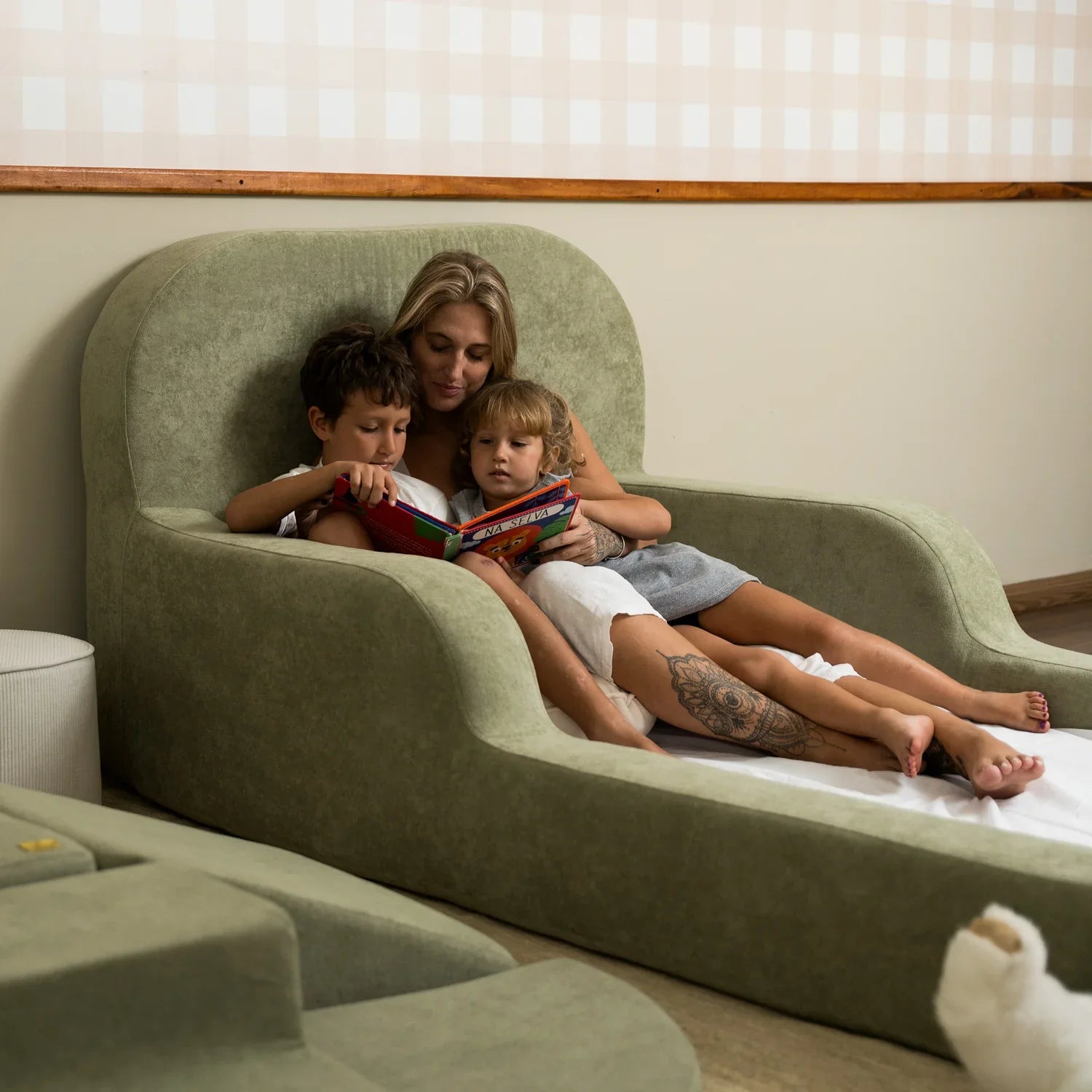

Leave comment
This site is protected by hCaptcha and the hCaptcha Privacy Policy and Terms of Service apply.